

IMA HISTORY
Since 1901 .....
1901
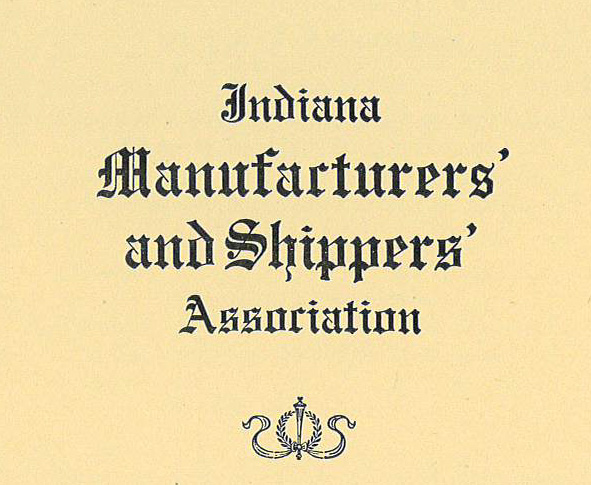
Founded as the Indiana Manufacturers' and Shippers' Association
-
The association was established during a period of rapid industrial growth in Indiana.
- Activities from 1900 to 1909 were centered around its establishment and initial mission to advocate for the state’s burgeoning manufacturing sector against a backdrop of labor unrest and increasing calls for government regulation.
1909
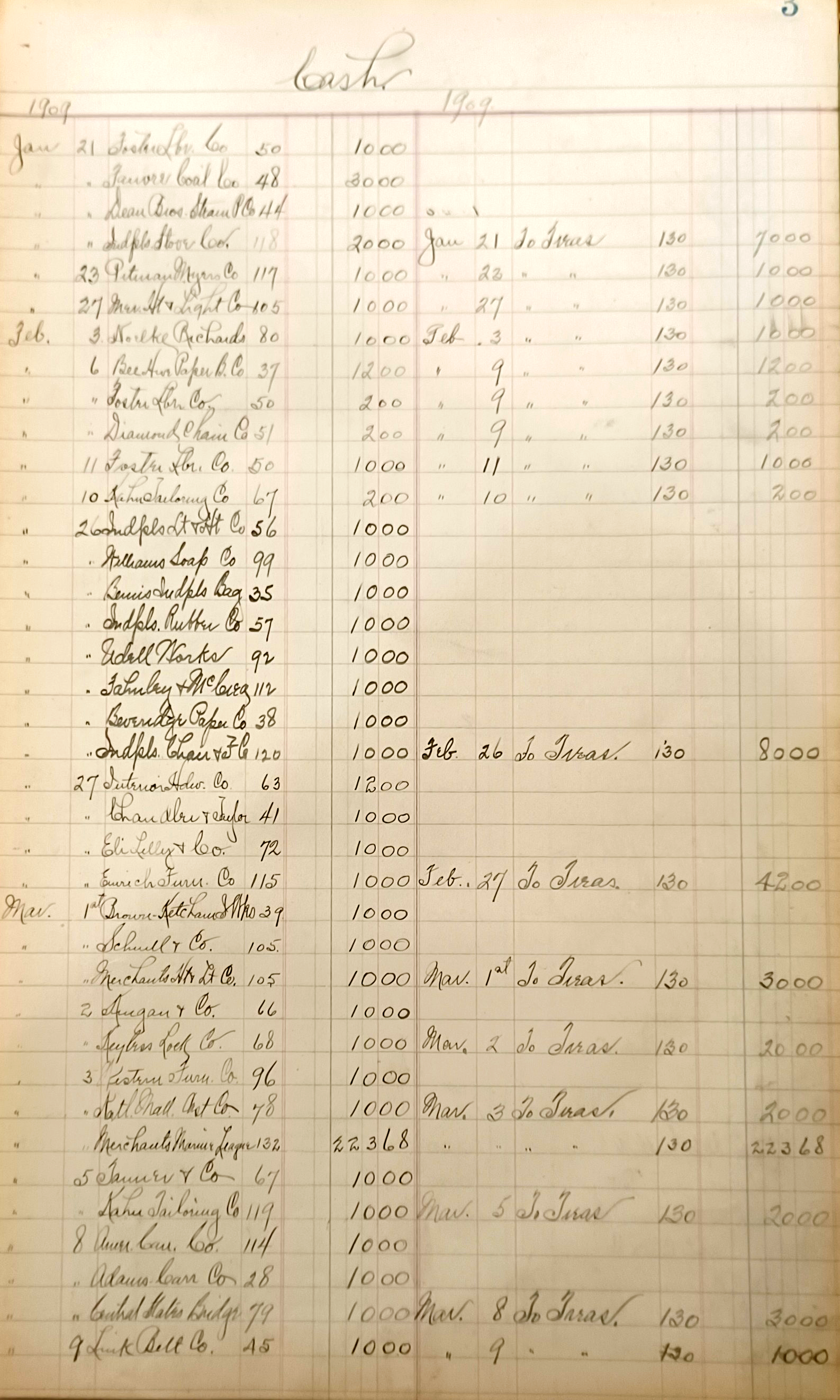
Earliest Dues Records Found
-
Founding members included:
- BP (originally Anglo- Persian Oil Co./1909)
- Cleveland Cliffs (originally Inland Steel/1893)
- Ford Meter Box Co., Inc. (est. 1898) -
Initial dues were $10/year.
1915

Registered New Name for Association
-
On Dec. 8, 1915, the association filed an application to change the name to the Indiana Manufacturers Association.
-
The application was signed by IMA President Edward Leigh of Marion Malleable Iron Works, Marion, Indiana; IMA Vice President C.T. Hertzsch of American Car & Foundry Co., Jeffersonville, Indiana; IMA Vice President Frederick Homes of Duncan Electric Manufacturing Co., Lafayette, Indiana; IMA Treasurer I.W. Lemaux, Security Trust Co., Indianapolis, Indiana; and IMA Secretary H.M. Cochrane of the IMA staff, Indianapolis, Indiana.
-
IMA focused on managing the challenges of rapid industrial expansion, including labor relations and government regulation, and coordinating manufacturers’ significant contributions to the World War I war effort.
Membership Grows
-
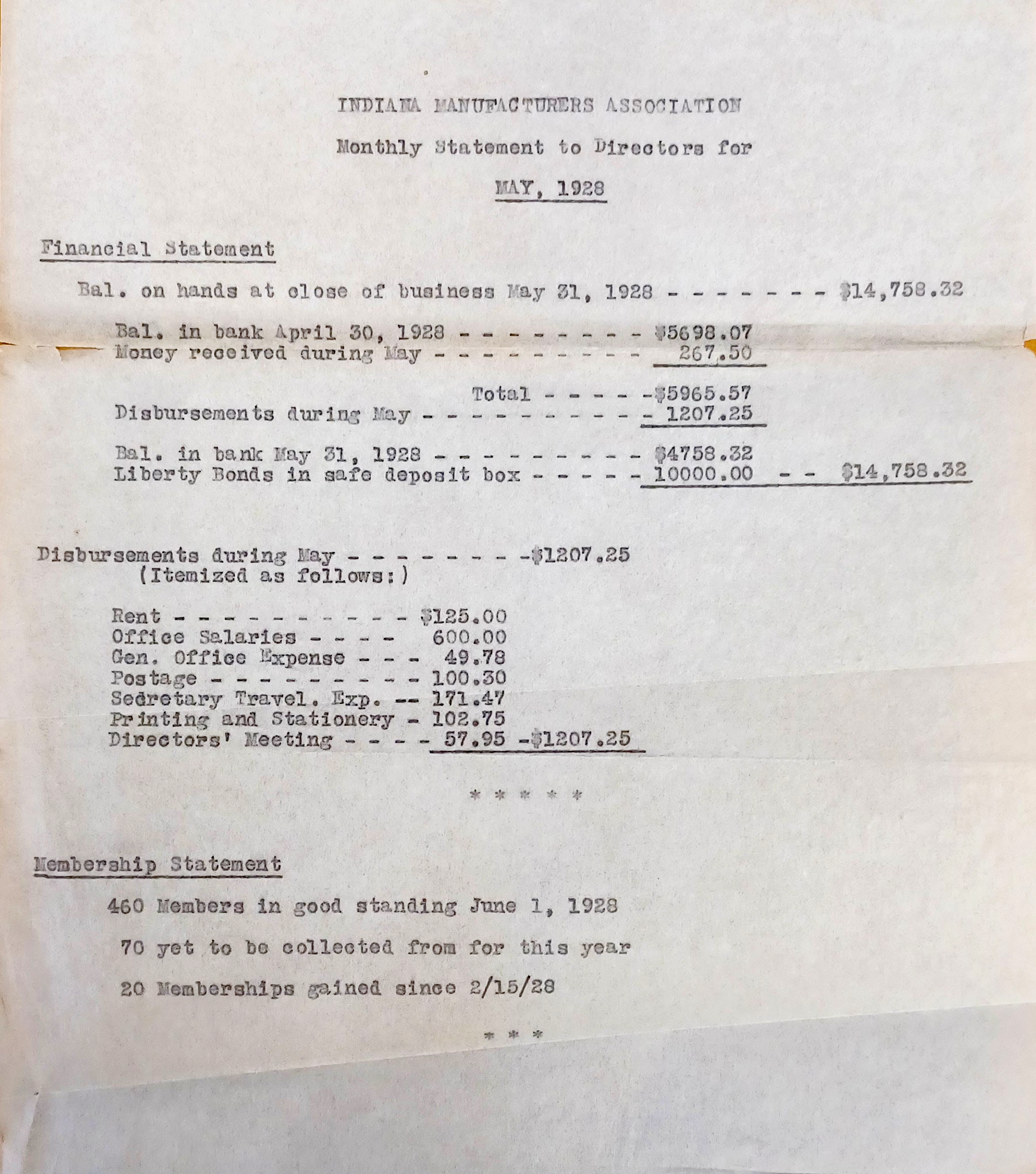
By 1928, the IMA had grown to 460 members, with a 20 member gain over the previous year.
-
The financial statement dated May 1928 showed a balance of $14,758.32. Office Rent was $125. Salaries were $600
-
IMA advocated for a stable, pro-business climate during the “Roaring Twenties” boom and the crash at the end of the decade. Primary activities and focus areas included advocating against “arbitrary and unnecessary official control” and “burdensome government regulations,” particularly regarding workplace conditions and taxes.
-
IMA championed private ownership and operation of businesses, opposing government ownership of industries like railroads.
1920s
1930s
Election Focus
-
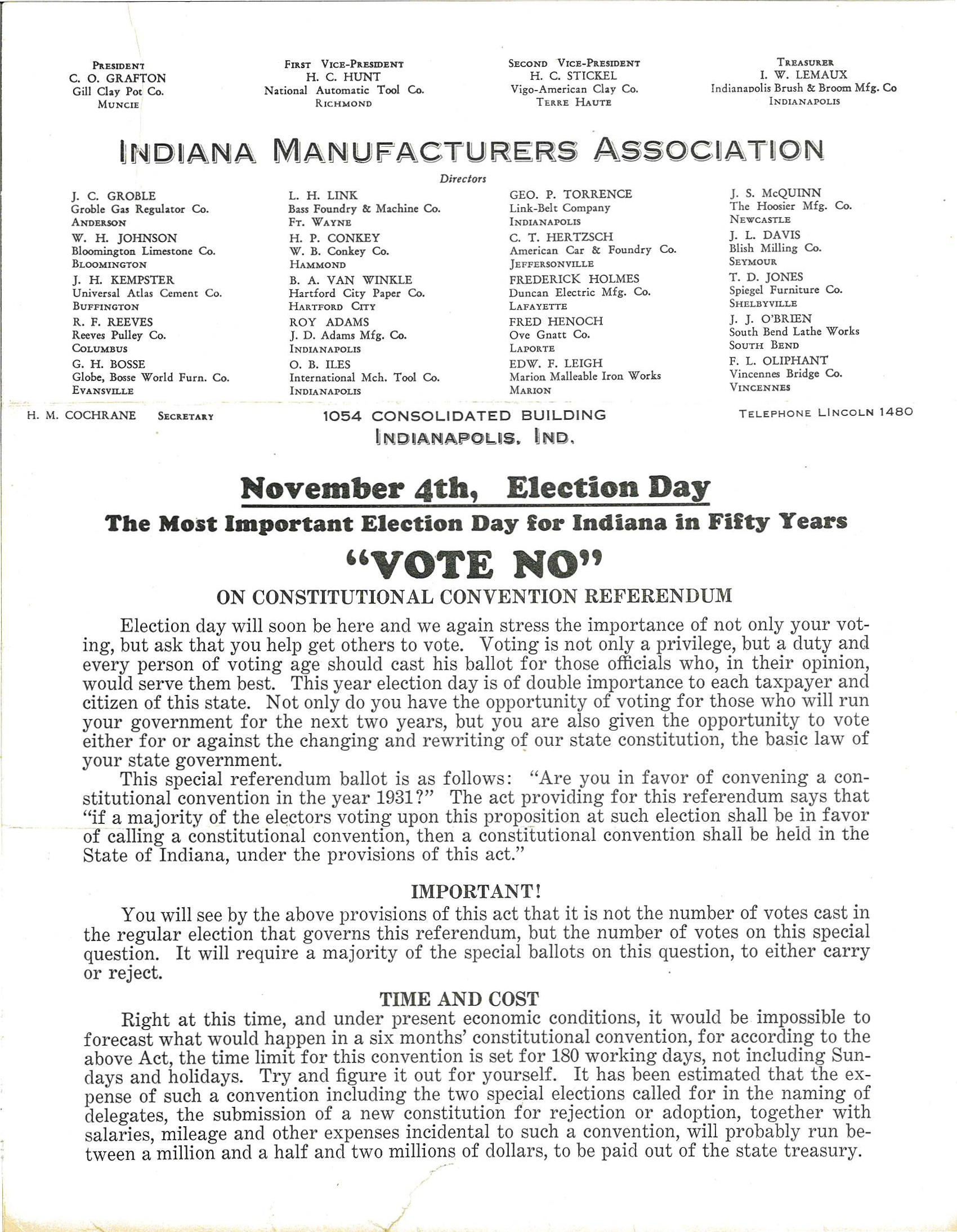
From the beginning, the IMA focused heavily on elections and guiding/protecting manufacturers on the public policy front.
-
This report from around 1930 sought to keep members informed about the upcoming elections and their importance in the upcoming vote on the state constitutional referendum.
-
The IMA focused on helping its members survive the devastating economic impact of the Great Depression while advocating against the extensive government intervention brought about by President Franklin D. Roosevelt’s New Deal programs.
-
By the late 1930s, as war broke out in Europe, the beginning of defense spending and industrial mobilization started to stimulate Indiana’s manufacturing sector, pulling it out of the Depression and setting the stage for massive production in the 1940s.
1940s
Policy Focus
-
Indiana became critical to the war effort. Steel mills ran 24/7, and new factories were built for wartime goods. The IMA helped coordinate this massive shift, acting as a liaison between the federal government and Indiana manufacturers to ensure efficient production of essential items like steel, aircraft engines, uniforms, etc.
-
Post-war, the IMA helped manufacturers convert their operations back to producing consumer goods.
-
IMA had 800 Members and 6 Departments.
-
IMA initiated the study of Workman’s Compensation.
-
The IMA had 4 member dues levels from $25-$100.
-
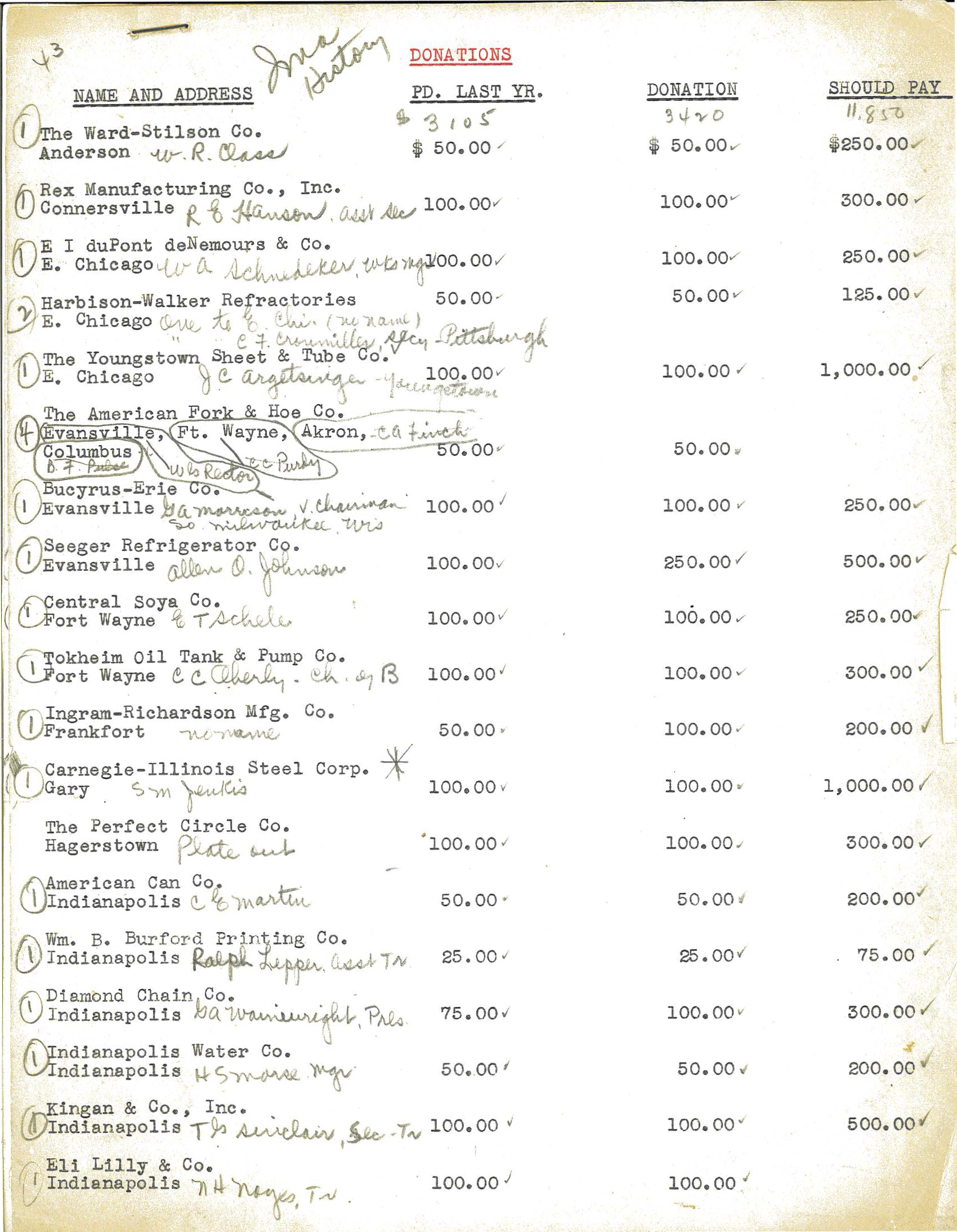
Art Conde became the first Executive Vice President of the IMA (now what is known as the President/CEO)
1950s
Growth and Change
-
The first issue of The Reporter was published in1951.
-
The IMA Budget was $100,000.
-
The IMA worked on Taft-Hartley Act and published the Glossary of Labor Terms.
-
The IMA Defense Production Committee was formed due to Korean conflict.
-
The Indiana Right to Work Committee was organized.
- Member dues went to an 11-tiered scale ranging from $30-$2,000.
-
IMA published the 1st edition of the Procedural Guide to Employee Relations (1957) and the Industrial Health & Safety Bulletin (1951).
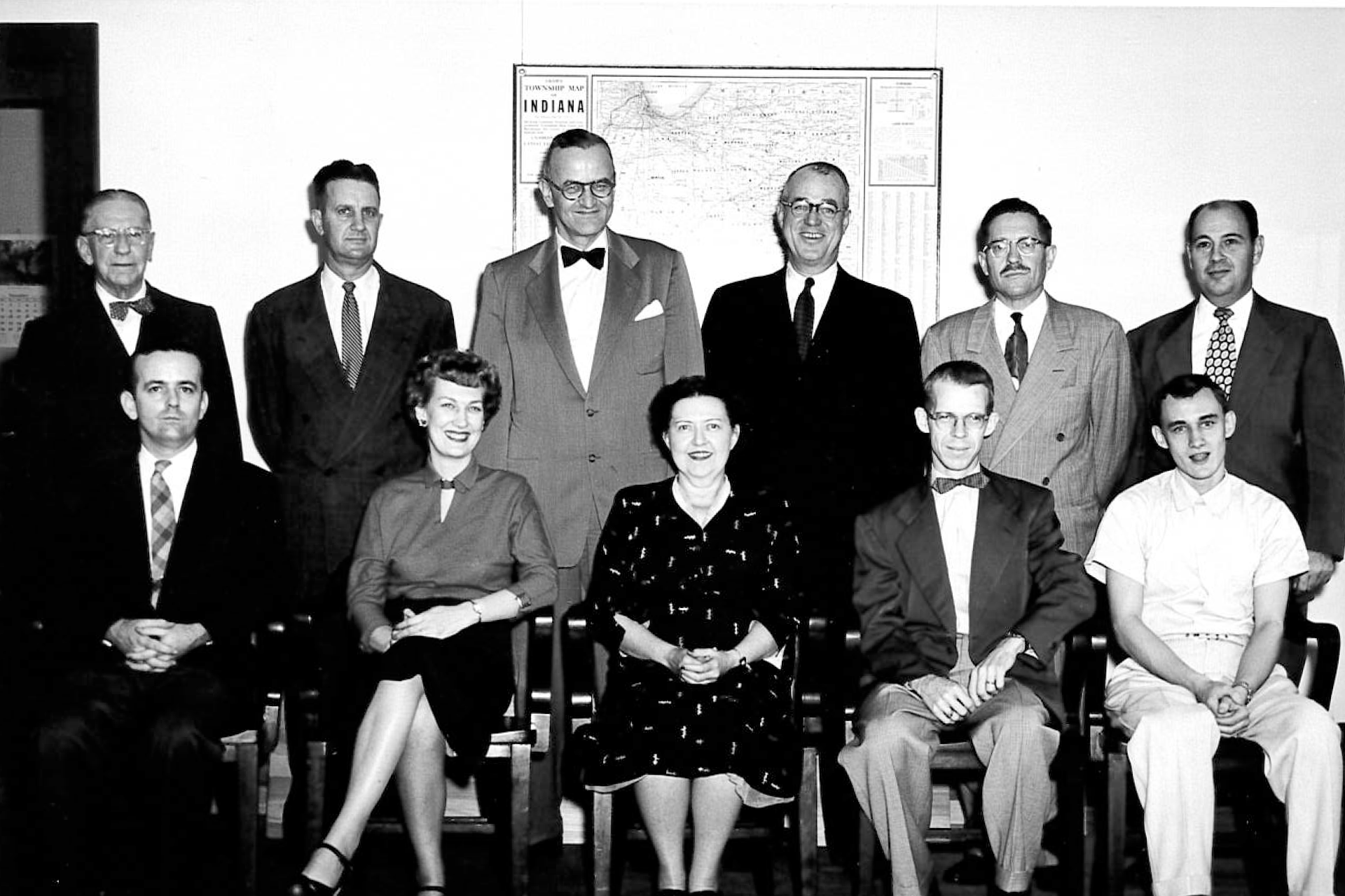
1955 IMA STAFF
Back row (left to right): Garvin Brown, Editor/Membership; Harold Schuman, Director of Industrial Relations; Arthur Conde, Executive Vice President; John Collins, Manager of Insurance Dept.; David Wilkinson, Manager of Legisaltion-Tax Department; George Sellers, Statewide Membership Sales;
Front row (left to right): Patrick Ward; Beulah Hoffner, Receptionist; Eunice Haerle, Secretary to the Exec. VP; Gaylord Gregson, Office Manager/Industrial Relations Assistant; Ronald Hendson, Manager of the print shop/supplies.
Increased Policy Advocacy
-
The IMA focused on helping members navigate a period of significant economic change, marked by the start of a decline in some traditional manufacturing sectors, increased national regulations, and the need for workforce development.
-
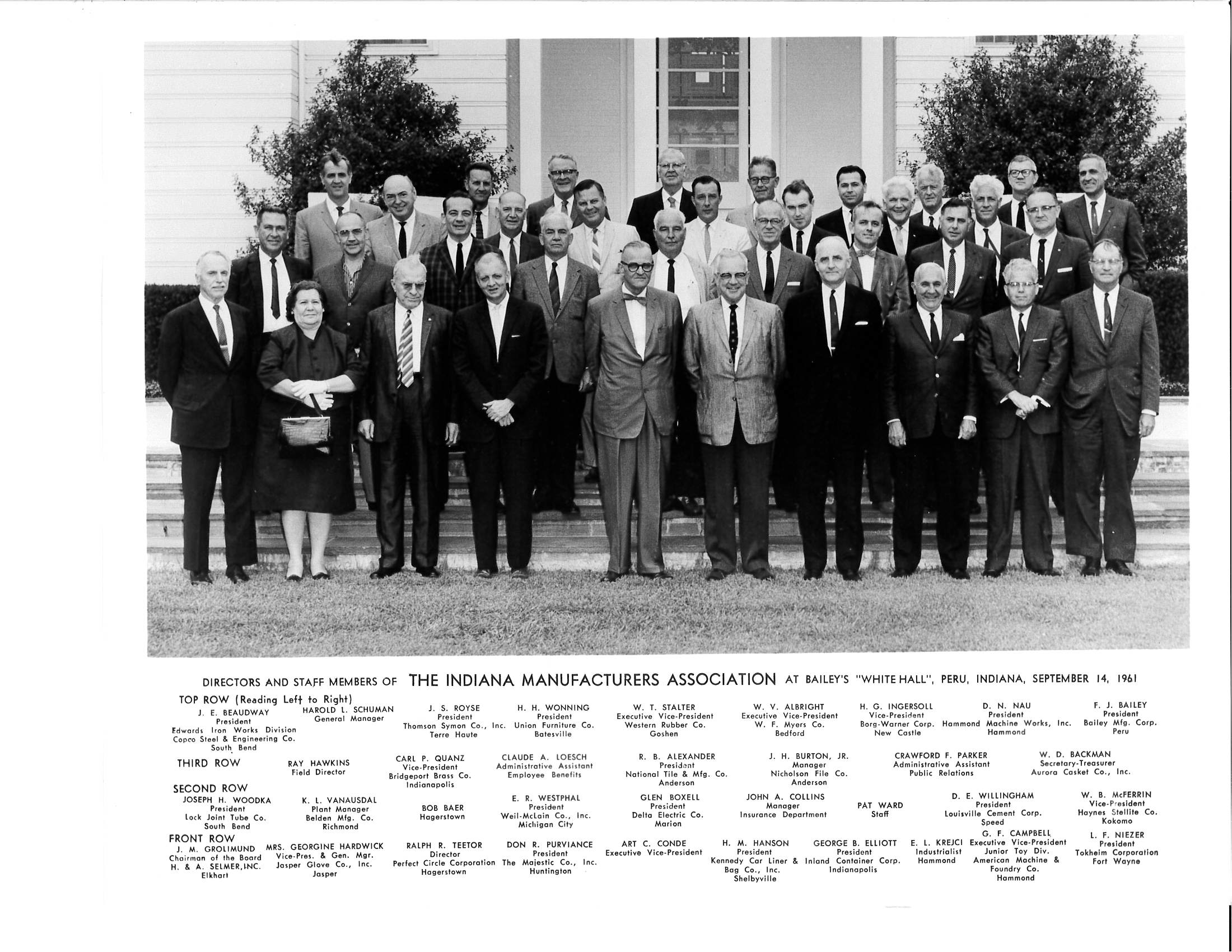
The first woman was elected to the IMA Board of Directors - Georgine Hardwick, VP & General Manager of Jasper Glove Company.
-
The IMA was involved in efforts to promote efficiency and modernization.
-
The IMA Air Pollution Study Committee formed.
-
Taxes were the number one issue for IMA members.
-
Robert Orr (IN Gov. from 1981-89) joined the IMA board of Directors (with the Indiana Archery Corp., Evansville, IN).
-
The Workman’s Comp program was introduced by the IMA Insurance Department.
1960s
1970s
Challenging Times for Our Industry
-
The IMA dealt with a challenging economic landscape marked by recession, an energy crisis, and significant new federal regulations.
-
Key concerns were the environment, labor unions, workplace safety/liability and increased taxes.
-
The IMA advocated for policies that would stimulate domestic energy production, and opposed government-imposed measures such as price controls and rationing it viewed as detrimental to business operations.
-
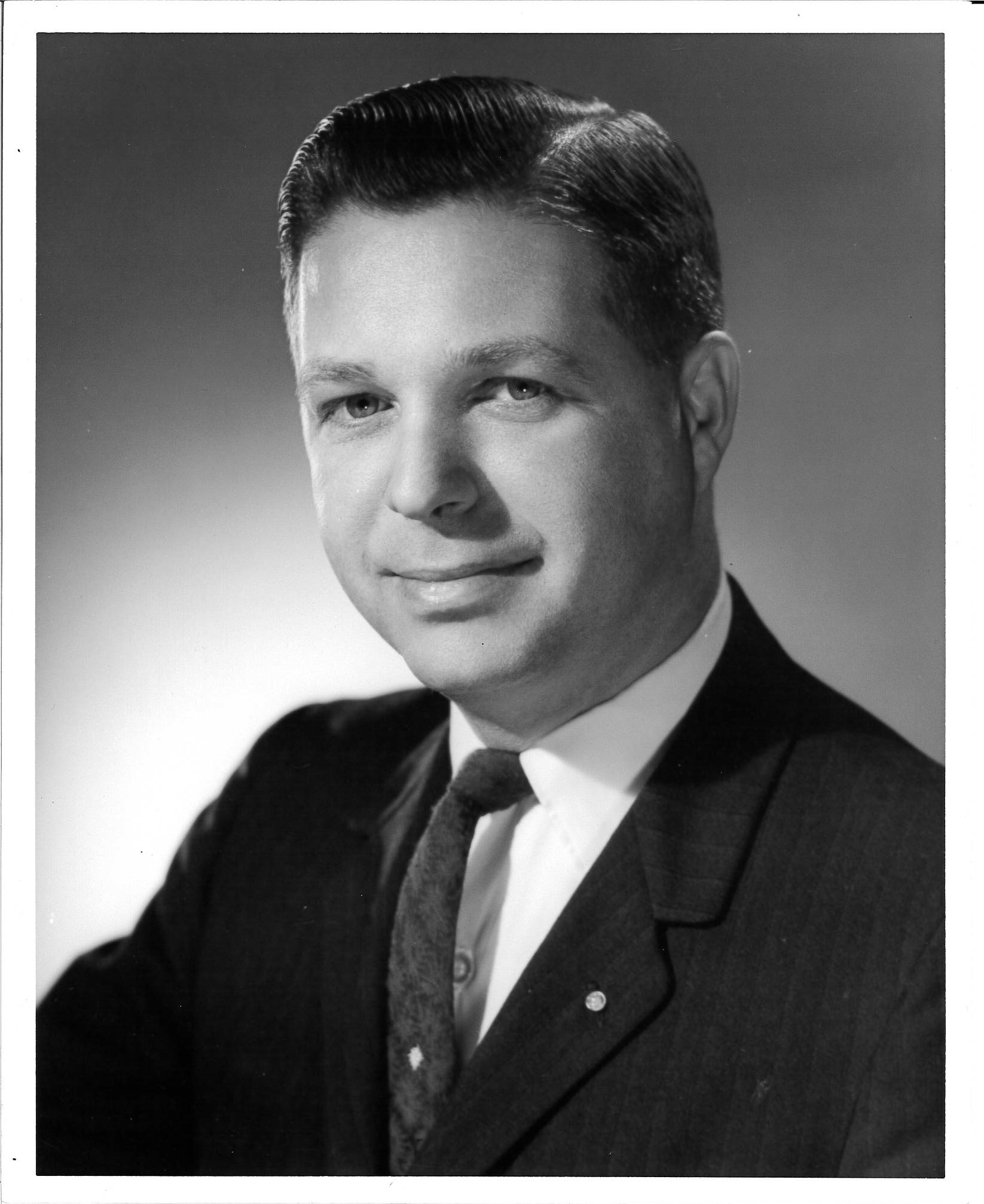
Fred McCarthy became Executive Vice President of the IMA in 1975.
-
The IMA regularly held its annual meetings at the French Lick Resort in West Baden, Indiana.
Fred McCarthy became the IMA President in 1975
1980s
Deregulation, Technological
Advancements and Globalization
-
The IMA worked to support members by advocating for cost-cutting measures and a general business environment that fostered recovery from two back-to-back recessions that hit manufacturers hard.
-
Indiana government, with IMA support and input, focused on developing economic strategies to enticing high-profile, high-tech, and high-wage manufacturers to move to Indiana.
-
Toyota and Honda opened plants in Indiana.
-
The IMA began offering a new property/casualty business insurance program to members.
-
The IMA revised its Laymen's Guide to Workmen's Compensation
-
The IMA purchased its first desktop computer.


1990s
Patrick Kiely became the IMA President in 1991
Skills Gap, First IMA Website,
Creation of Indiana Business Network
-
IMA activities centered on advocacy for a positive business environment to help members navigate the dual challenges of a changing national economy and increased globalization.
-
The IMA played a significant role in highlighting and addressing the gap between the skills of potential employees and the demands of entry-level manufacturing jobs.
-
The IMA created its first website.
-
The IMA created its first online database.
-
The IMA worked to manage the impact of solid waste legislation.
-
During the 1990s, the IMA updated its print publication to the new IMANET newsletter.
-
IMA created the Indiana Business Network (IBN) and started its discount shipping program.
2000s
Legislative Victories
-
The IMA's most significant achievements in the 2000s centered on major tax restructuring and the ultimate repeal of the business inventory tax, which was a long-held policy goal.
-
The IMA continued to lobby for a “common-sense” regulatory environment that reduced the financial burden on manufacturers and helped them remain competitive against international producers who did not have to adhere to the same environmental and safety standards.
-
The IMA formed the ISO9000 Users Group to assist companies in becoming ISO certified.
-
The IMA took on the US Senate Productivity Award for Senator Richard Lugar’s office.

US Senate Productivity Award Committee Members Review Applications for the 2005 Awards
Manufacturing's Longest Expansion
2010s
-
IMA activities focused heavily on workforce development, solidifying tax reforms, and navigating complex regulations to ensure Indiana remained a national leader in manufacturing.
-
The IMA’s work in the 2010s helped contribute to the longest manufacturing employment expansion in state history by 2018, and ensured that manufacturing as a share of state GDP remained the highest in the nation.
-
Indiana’s Right-to-Work law was passed in 2012 through the efforts of the IMA and other business organizations.
-
Brian Burton became IMA President/CEO in 2015.
-
IMA instituted the Manufacturers Hall of Fame and the Manufacturing Excellence Awards beginning in 2016.
-
IMA began a series of statewide summits/plant tours at IMA member facilities to connect Hoosier manufacturers.
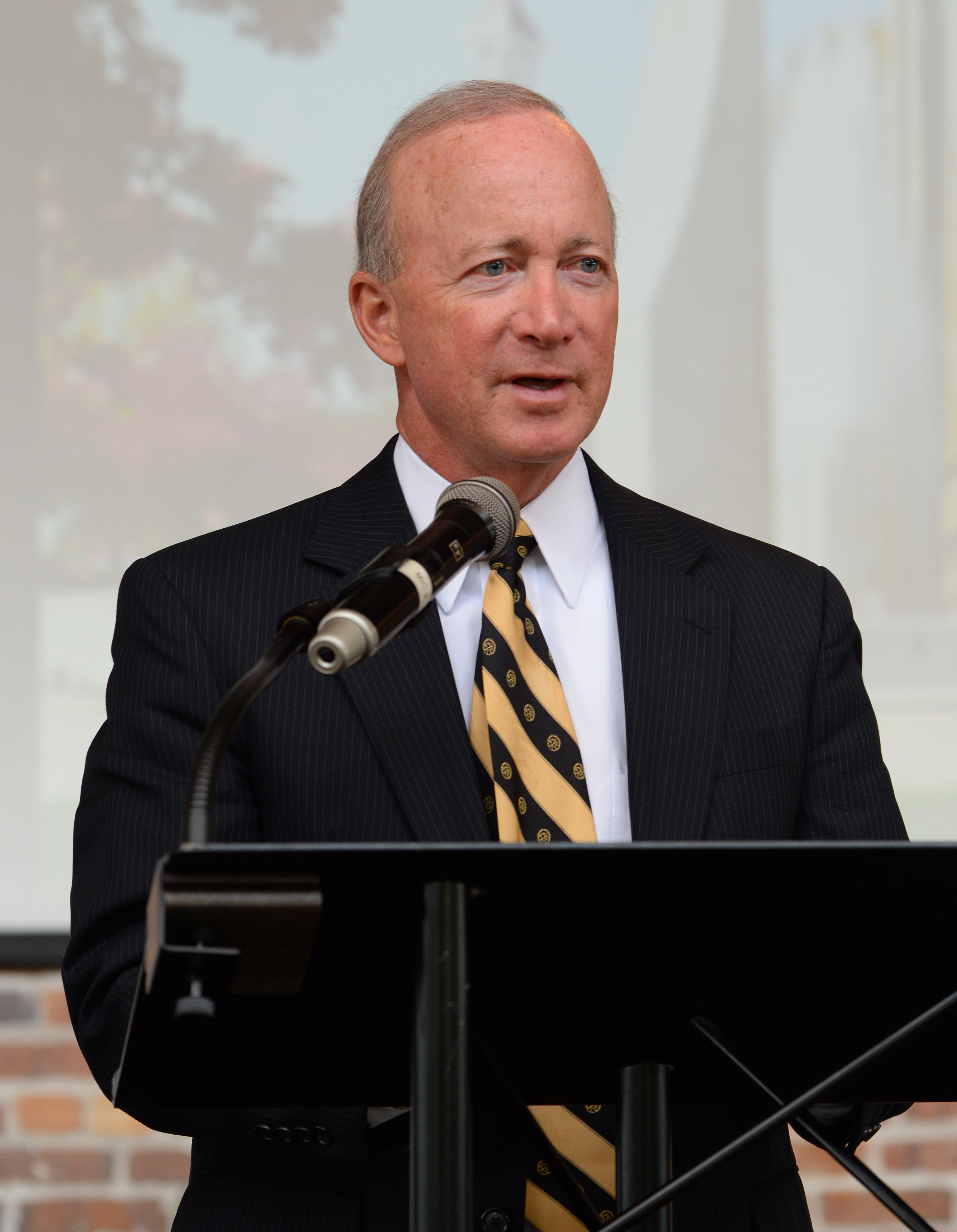
Governor Mitch Daniels was the keynote speaker at the IMA's first Manufacturers Hall of Fame Luncheon in October of 2016.
What's Old is New
-
IMA activities in the 2020s have been primarily focused on helping members navigate and recover from the COVID-19 pandemic, addressing severe supply chain disruptions, tackling critical workforce shortages, and advocating for policies that support industrial modernization and competitiveness.
-
Andrew Berger became IMA President/CEO in January 2025.
-
The most significant state-level victory was the passage of Senate Bill 1 (SB 1) in 2025, a comprehensive property tax relief package that included key wins for manufacturers, including an increased small business exemption and the elimination of the 30% depreciation floor.
-
IMA rebranded with a new logo and website in January 2025.
-
IMA moved its offices to 30 South Meridian in 2025.
2020s

The IMA rebranded in 2025
with a new logo and website.